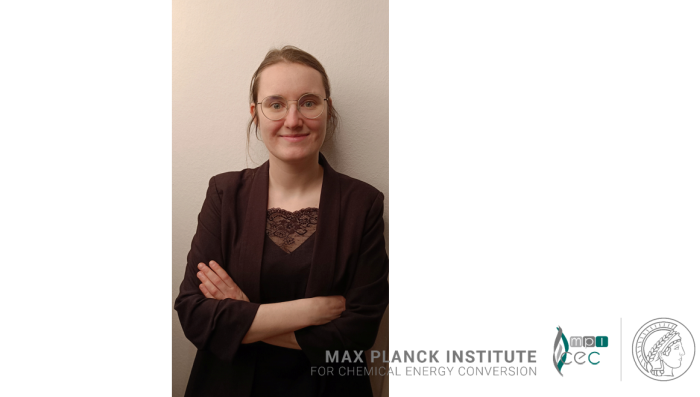
My name is Hannah Stieber and I work at the Max Planck Institute for Chemical Energy Conversion (MPG) in Mülheim an der Ruhr. I studied chemical engineering at TU Dortmund University and am currently working on my dissertation. My role in the E-Tandem project is to design, build, and operate the mini-plant for demonstrating the reaction in continuous operation.
What is your (main) research area today?
My main focus is on scaling up catalytic reactions, which have previously been carried out on small scale in the laboratory, to a mini-plant. In addition to scaling up, the main aim is to transfer the process to continuous operation. In our research group, we place particular emphasis on the recycling of homogeneous catalysts, which is a major challenge when using homogeneous catalysts.
What is the main objective of your team in E-TANDEM?
Our team is involved in developing catalysts for converting e-syngas into higher alcohols and ethers as part of Work Package 2, as well as demonstrating continuous operation as part of Work Package 4. In addition to developing a stable process, our main tasks here were planning a possible process and investigating the possibility of catalyst recycling using membranes. These findings were then incorporated into the design and construction of the mini-plant. As a final step the operation of the mini-plant is the main focus of our team.
What expertise and facilities does your team have to meet those objectives?
Our group consists of chemists and engineers which gives us extensive experience in both carrying out and optimizing reactions, particularly hydroformylation, and in planning and constructing mini-plants. This is very important for scaling up reactions into a continuous operation. We also have a well-equipped technical center where the mini-plant could be set up and commissioned relatively quickly within the project time frame. In our institute, the researcher are supported by highly competent technical staff in our workshops, who can make custom-made items for us. This is crucial when implementing a new process.
Which aspects of your research at E-TANDEM do you believe are the most innovative and what unique opportunities does E-TANDEM offer to you and/or your organisation?
The combination of heterogeneous and homogeneous catalysis within a continuous one-pot reaction makes the E-TANDEM project highly innovative. In addition, the production of e-fuels through the integration of a co-electrolysis system with catalytic reaction steps, together with challenging downstream separation processes involving a wide range of separation techniques, represents a significant technological advance. Furthermore, E-TANDEM offers an excellent opportunity to collaborate with various international partners and to apply our expertise toward making future industrial fuel production processes more sustainable.
How do you see the future use of the E-TANDEM results and the impact of the E-TANDEM project in our daily lives?
In general, the E-TANDEM project provides a promising pathway to make the production of marine fuels more sustainable. But beyond that, I also like holistic approach used in this project. Not only the reaction but also syngas production, fuel characterization, and the sustainability of the product will be considered. This will not only result in important findings and developments for the E-TANDEM project, but also in interesting insights and progress in many of the sub-areas considered in the project, which may be beneficial in other processes as well. For my research field for example, the combination of heterogeneous and homogeneous catalysis and scale-up, is generally an interesting concept that could be applied in other processes, not only fuel production, to make them more efficient and sustainable.